Multiplicity and Uniqueness of Equilibria in Continuous-Time Dynamic Discrete Choice Games
Jason R. Blevins and Youngjae Jeong.
The Ohio State University, Department of Economics
Working paper.
Availability:
- Draft available upon request
- Replication code
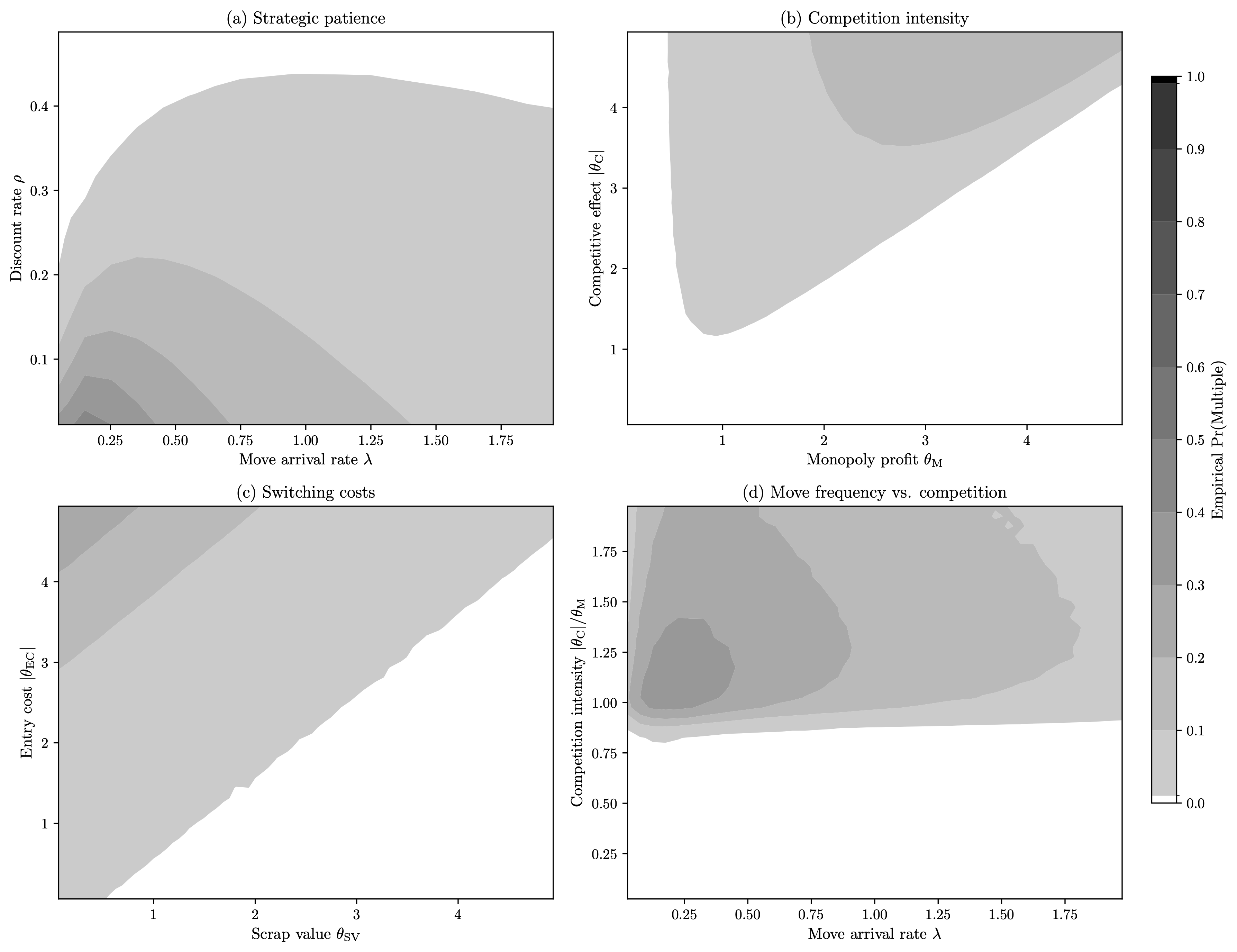
Abstract. We consider multiplicity and uniqueness of equilibria in continuous-time dynamic discrete games where players move sequentially according to independent Poisson processes. With multiple equilibria, the structural model is incomplete: the reduced form and counterfactual predictions depend on how equilibria are selected. We provide what are, to our knowledge, the first closed-form sufficient conditions for uniqueness of Markov perfect equilibrium in this class of games. The conditions are semiparametric and can be verified from model primitives. To measure the coverage of the conditions and characterize multiplicity more broadly, we carry out a large-scale numerical search for equilibria of a dynamic duopoly model of entry and exit. Although uniqueness is the norm in our broad search, we find that multiplicity concentrates in economically relevant regions: where the market cannot profitably sustain both firms, where firms are very patient, and at intermediate decision frequencies that balance strategic interaction and commitment. We show that when multiple equilibria occur, a naïve full-solution estimator can converge to an equilibrium that did not generate the data, and counterfactual predictions depend on equilibrium selection.
Keywords: Stochastic games, continuous-time games, dynamic discrete-choice games, Markov perfect equilibrium, equilibrium uniqueness, equilibrium multiplicity, equilibrium selection.
JEL Classification: C57, C62, C63, C73, L13.
BibTeX Record:
@TechReport{blevins-jeong-wp,
    author      = {Jason R. Blevins and Youngjae Jeong},
    title       = {Multiplicity and Uniqueness of Equilibria in
                   Continuous-Time Dynamic Discrete Choice Games},
    type        = {Working Paper},
    institution = {The Ohio State University},
    year        = 2026
}